Off-Plan Marketing Visuals: What Boutique Developers Should Ask For
Selling a development before it is built is an act of trust. The buyer cannot walk the rooms, stand on the balcony, or check the afternoon light in the living room. Everything they decide is decided on the strength of your marketing visuals. For boutique developers — who cannot outspend the big players on volume — every image has to work harder.
Here is what to ask for when commissioning off-plan renders, so the package survives the entire campaign from launch to final sale.
1. The right views, not the most views
A common mistake is ordering every possible angle. A tighter set of well-chosen views outperforms a large set of indifferent ones. For a typical boutique residential project, the essential package is:
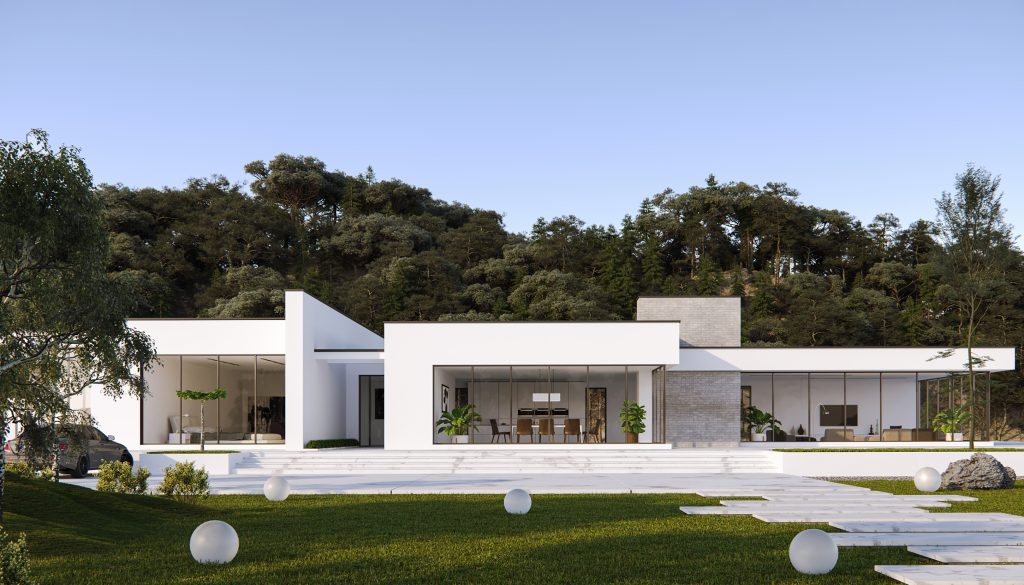
- One hero exterior — the image that anchors the brochure, the listing, and the billboard. Usually a dusk or golden-hour view. For a multi-residence scheme like our KurPark exterior series, or a single modern house in Perth, this street-level hero image will be seen ten times more than every other view combined.
- One daylight exterior — for credibility. Buyers and agents trust a scheme they have seen in honest light.
- Two to three interiors — the living space, the master bedroom, and one more (kitchen or bathroom). These are where buyers picture their lives.
- One context or aerial view — location sells. Show the neighbourhood, the street, the outlook buyers are paying for.
Anything beyond this should earn its place. Each additional view should answer a specific buyer question.
2. Resolution that survives print
Ask for the delivery resolution upfront. Web listings are forgiving; a sales-gallery wall or a billboard is not. A good rule: request finals at a resolution that covers your largest planned use, plus print-quality and web-optimised versions of every image. It is far cheaper to specify this at the brief stage than to re-render later.
3. Lifestyle art direction, honestly done
Off-plan buyers are not buying floor area; they are buying a life. That means styled interiors — furniture, soft furnishings, table settings, the sense that someone lives here. But there is a line: styling should suggest the lifestyle the architecture enables, not disguise the architecture itself. Work with a studio that understands that distinction.
4. A revision structure you can plan around
Rendering is iterative. Agree the revision rounds before production starts: typically a draft review for composition and a refinement round for materials and lighting. Know what counts as a revision versus a scope change (a new view, a redesigned facade). Clear terms keep the project on schedule and the relationship healthy.
5. Licensing without surprises
Confirm you receive full commercial usage rights for marketing the development — brochures, listings, advertising, sales displays. Most professional studios include this as standard, but ask explicitly. You do not want to discover usage limits mid-campaign.
6. Consistency across the package
The hero exterior, the interiors, and any animation should feel like one project. That means one studio, one art direction, one lighting logic. A patchwork of suppliers producing slightly different buildings is one of the quietest ways to undermine buyer confidence.
Working with a remote studio
Many boutique developers now commission visualization internationally — and the model works well when communication is tight. We produce off-plan packages for developers in Australia, the USA, and Germany from brief to final delivery — from multi-residence developments like our KurPark and No.397 Berlin exterior series to single modern houses in Sydney (No.38 Elena Street) and Perth — working directly from architectural drawings and material schedules. The essentials are the same as with a local studio: a clear brief, agreed views, structured revisions, and a single creative eye across the package.
Before your next launch, send us the drawings and tell us where the images will be used. We will scope the package to the campaign — nothing more, nothing less.
A-R Studio — Photorealistic 3D rendering & visualization for architects & developers. Australia · USA · Europe.