How Photorealistic Renders Help Small Architecture Firms Win Competitions
Architecture competitions are decided in minutes. A jury reviews dozens — sometimes hundreds — of entries, and each board gets a short window of attention before the discussion moves on. In that window, your design has to do two things at once: communicate clearly and make people feel something. This is where photorealistic visualization earns its place.
Clarity wins before beauty does
The most common mistake small firms make with competition visuals is treating them as decoration for an already-finished board. The render is not the garnish; for most jurors, it is the first — and sometimes the only — reading of the project. Plans and sections prove the architecture works. The visualization proves it is worth building.
A good competition render answers three questions instantly: What is the big idea? How does it sit in its context? What does it feel like to be there? If a juror has to hunt for those answers, the board is already losing.
What juries respond to
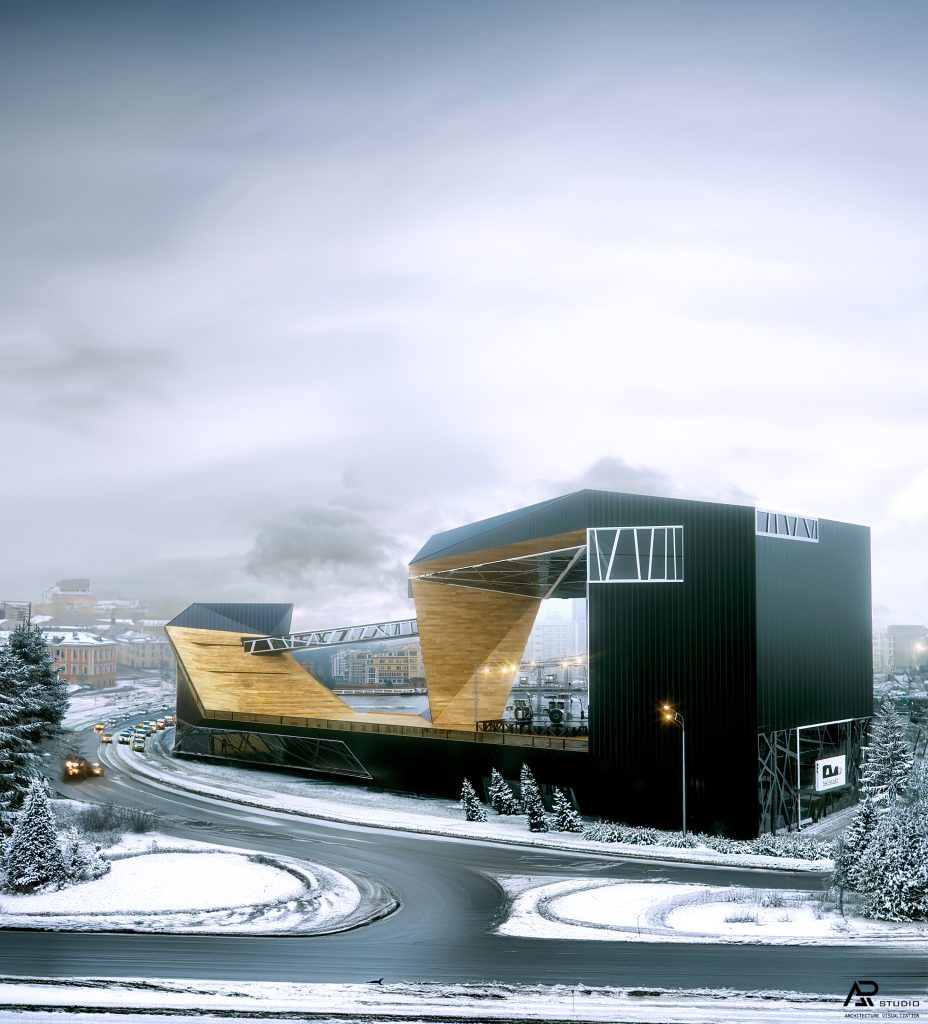
Having produced competition visuals for practices in Australia, the USA, and Germany — from cultural work like our Nordhavn Museum series to residential competition material for modern houses in Sydney, Perth, and Berlin — we have seen patterns in what holds a jury’s attention:
One strong idea per image. The most effective competition renders commit to a single message — the arrival sequence, the relationship to the street, the light in the main hall. Images that try to show everything end up communicating nothing.
Context, not fantasy. Jurors are architects; they can spot a render that flatters the building by erasing its surroundings. Accurate context — neighbouring buildings, real topography, honest daylight — builds credibility. A beautiful lie might catch the eye, but a believable truth wins the argument.
Atmosphere as argument. Competitions are ultimately about judgment, and judgment is emotional as much as analytical. The quality of light, the sense of scale with human figures, the materiality you can almost touch — these are not stylistic extras. They are how you make a jury believe in the experience of a building that does not exist yet.
Briefing a visualization studio for competitions
Competition work has constraints that regular marketing renders do not: tight deadlines, evolving designs, and strict submission rules about what can be shown. A few briefing habits make the difference:
- Share the concept narrative, not just the model. Tell the studio what the project is about. The best competition images are composed around the idea, not around the geometry.
- Lock the views early. Decide which two or three views carry the submission, and let the design team keep refining everything else. Chasing a moving design across six views is how deadlines die.
- Ask for honest daylight first. Dusk hero shots are seductive, but juries trust clear daylight views. Get the daylight image right; the dramatic variant is a bonus.
- Check the rules. Some competitions restrict photomontage or require specific viewpoints. Brief the studio on the constraints upfront.
The small-firm advantage
Large offices have in-house visualization teams. Small firms do not — and that is not the disadvantage it appears to be. A specialist studio brings a fresh eye to every project and a production pipeline built for exactly this kind of sprint: fast modelling from your CAD or SketchUp files, art direction that serves the concept, and delivery tuned to submission deadlines.
We have supported competition entries across residential, cultural, and public projects — from a modern house in Perth to the public spaces of the Nordhavn Museum series. The pattern is consistent: firms that invest in clear, atmospheric, honest visuals give their ideas the hearing they deserve.
If you have a competition on the horizon, talk to us early — the earlier the visualization thinking starts, the stronger the board finishes.
A-R Studio — Photorealistic 3D rendering & visualization for architects & developers. Australia · USA · Europe.